111-1024x458.png)
BLOG
CONTACT US
3-in-1 Laser Welding Machine for U.S. Workshops: Save Space, Simplify Workflows
Walk into any thriving American workshop—from a family-owned repair shop in Ohio to the maintenance bay of a large Texas manufacturing plant—and you’ll feel the pressure. Not just the pressure of deadlines, but the physical pressure of cramped floor space and the operational pressure of fragmented workflows. Every square foot costs money, and every time a job moves between stations, you lose time and introduce risk. But what if the solution to both wasn’t buying more space or hiring more hands, but consolidating your tools? Enter the 3-in-1 Laser Welder Machine: a disciplined approach to doing more with less, precisely what American industry was built on.
Chapter 1:The Hidden Tax of "Spread-Out" Production in the USA
1.1 The Real Estate Crisis on Your Shop Floor
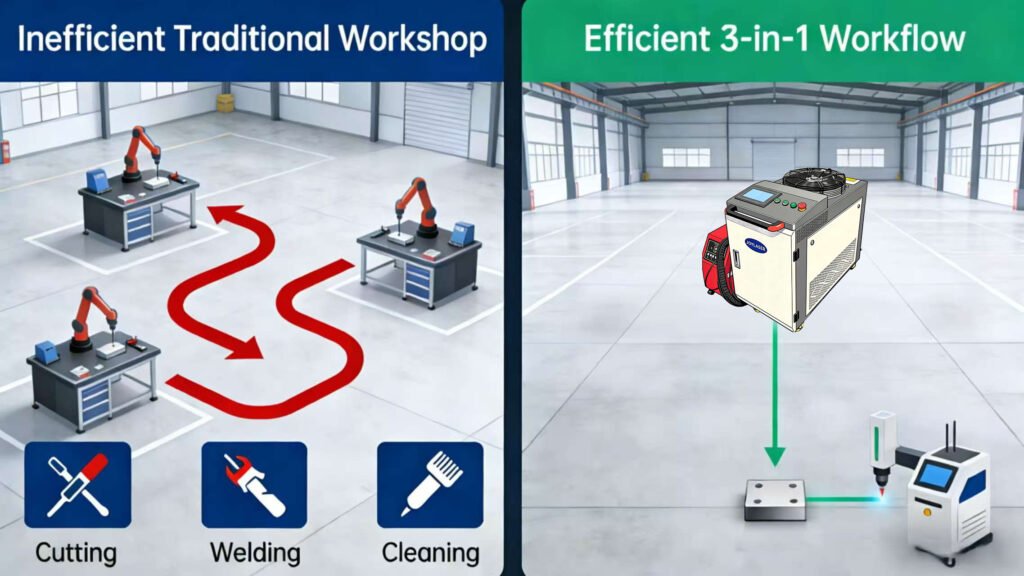
In industrial hubs from the Midwest to the Sun Belt, commercial space is at a premium. Leasing more square footage is a capital-intensive, long-term commitment. More critically, inefficient use of existing space is a silent profit killer. Dedicate corners to a dedicated cutter, a welder, and a cleaning station, and you’ve not only tripled your equipment investment but also created a triangle of wasted travel time and duplicated utilities (power, air, fume extraction).
1.2 The Workflow Bottleneck: When Handoffs Create Hold-Ups
A simple repair job—like fixing a cracked bracket—becomes a logistical puzzle: Move the part to the shear or saw for trimming. Move it to the welding bench. Move it again for post-weld cleaning and inspection. Each move risks damage, misplacement, or queueing delays. This “processional manufacturing” for small-batch work kills the agility that modern U.S. shops need to survive.
Chapter 2: The Integrated Solution: Deconstructing the 3-in-1 Laser Welder Machine
2.1 Three Core Functions, One Unified Platform
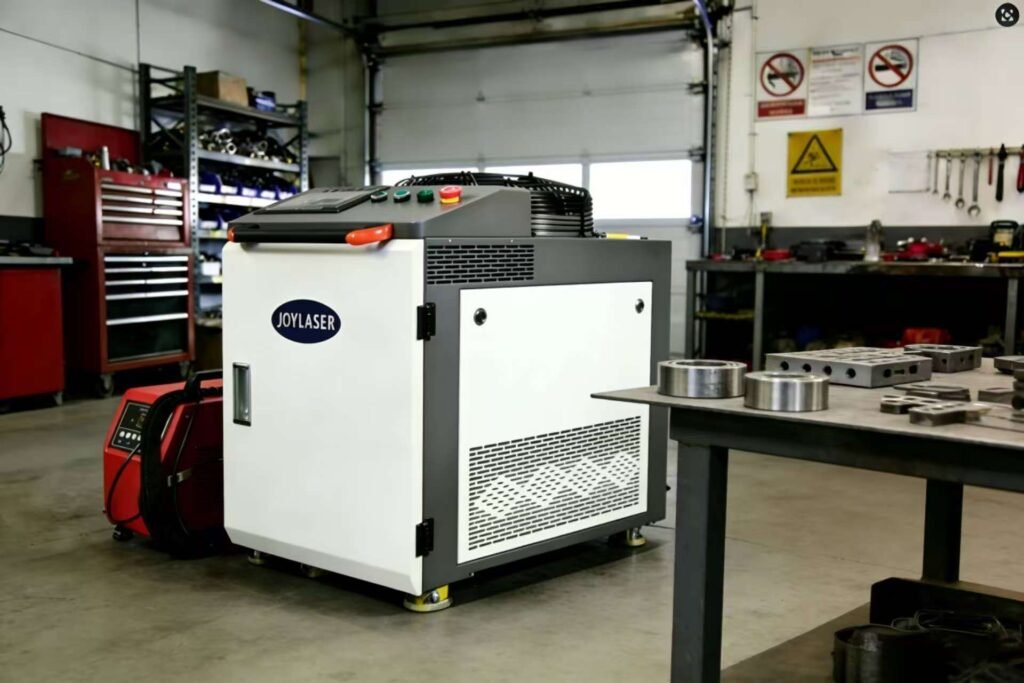
The JOYLASER 3-in-1 system is engineered not as three machines bolted together, but as a single, intelligent platform with three focused capabilities:
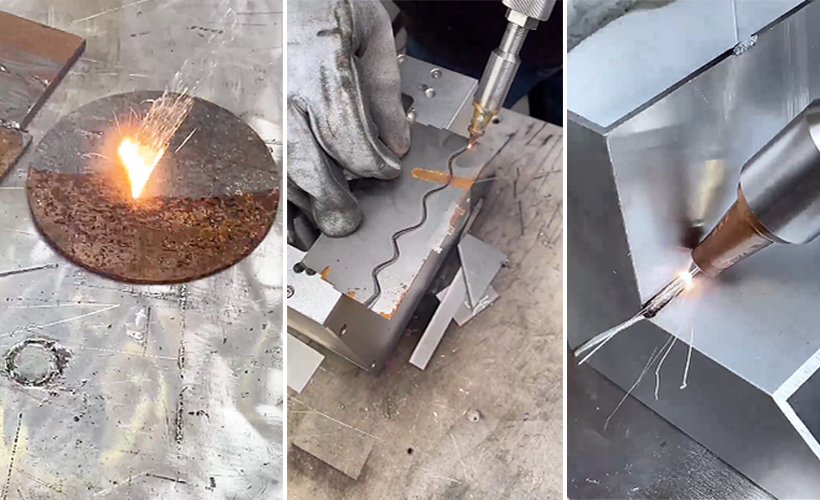
Precision Welding: Utilizing focused laser energy for strong, clean, low-heat-input welds on a variety of metals.
Cutting (for Light Gauge): Effectively cutting thin sheet metal, tubes, and profiles for prototyping, repair patches, or small-part fabrication. (We are upfront: for heavy plate, a dedicated high-power cutter is advised. This is about versatility within a sensible scope.)
Non-Abrasive Cleaning: Removing rust, oil, paint, and coatings from metal surfaces using laser ablation—leaving the base material intact and eliminating chemical or media waste.
2.2 The Strategic Advantage: Flexibility Over Fragmentation
The power isn’t just in having three tools, but in the seamless transition between them. A technician can cut a replacement shim, weld it into place, and immediately clean the heat-affected zone—all without unclamping the workpiece or changing locations. This turns a multi-stage, multi-hour task into a continuous, focused operation.
Chapter 3: Where the ROI Comes From: Quantifying the Consolidation Benefit
3.1 Direct Cost Savings: More Than Just Machine Price
Compare the total cost of three entry-level single-function machines (a cutter, a welder, a cleaner) versus one integrated 3-in-1 unit. The savings extend beyond the invoice:
Reduced Footprint: Free up floor space for revenue-generating activities or additional capacity.
Lower Utility Hookups: One power source, one air connection.
Simplified Training & Maintenance: Operators master one system; you maintain one set of core components.
3.2 The Greater ROI: Agility and Opportunity Cost
The true value is operational. How much is it worth to…
Complete a repair 60% faster and get the asset back in service?
Accept a last-minute, multi-process job because you know you can handle it without bottlenecks?
Empower a single skilled worker to see a complex task through from start to finish, boosting accountability and job satisfaction?
(Table: Comparison of Two Approaches)
Consideration | Traditional Three-Station Setup | JOYLASER 3-in-1 Laser Welder |
Floor Space Required | High (3 separate zones) | Low (1 compact station) |
Part Handling & Movement | Extensive, risk of damage/delay | Minimal, part often stays clamped |
Setup & Changeover Time | Slow (between processes) | Fast (integrated system) |
Operator Skill Focus | Fragmented (3 specialties) | Consolidated (mastery of one platform) |
Ideal Use Case | High-volume, dedicated production lines | Low-volume, high-mix, repair, and prototyping |
Chapter 4: Real-World Scenarios: The 3-in-1 in Action Across America
Scenario A: The Maintenance & Repair Hub
A Michigan-based hydraulic cylinder repair shop uses their 3-in-1 laser to: Cut new gland seals from sheet packing, Weld cracked mounting lugs, and Clean piston rods for inspection. What used to involve coordinating across the shop now happens at one vise, slashing repair turnaround time.
Scenario B: The Prototyping & Small-Batch Workshop
A California tech startup developing automated equipment constantly iterates on brackets and enclosures. The 3-in-1 allows them to cut aluminum components, weld assemblies, and clean markings for anodizing in a continuous, fluid process, accelerating their R&D cycle.
Chapter 5: Making the Strategic Choice: Is a 3-in-1 Right for Your Shop?
The JOYLASER 3-in-1 Laser Welder Machine isn’t for everyone. It’s the strategic choice for the agile, forward-thinking American workshop that values:
Versatility over single-function raw power.
Floor space efficiency as a critical resource.
Workflow continuity for jobs that don’t fit a mass-production model.
It’s the ultimate tool for repair departments, job shops, fabricators dealing with diverse materials, and maintenance cells within larger plants—anywhere that every square foot and every minute between order and completion counts.
Conclusion: Consolidate Your Tools, Amplify Your Capability
The challenge of space and fragmented workflow isn’t going away. The question is whether you’ll manage it with an ever-growing collection of single-task tools, or address it head-on with integrated intelligence. The JOYLASER 3-in-1 Laser Welder Machine represents a commitment to leaner, smarter, and more responsive manufacturing.
Ready to see if consolidating to a 3-in-1 laser welder machine unlocks space and efficiency in your operation?
[Contact the JOYLASER U.S. Team for a Custom Workflow Analysis]
FAQs: Your Questions on the 3-in-1 Laser Welding Solution
Q1: Who is this machine really for?
A: It’s designed for shops that handle diverse, small-to-medium batch tasks. It’s the ideal choice for repair centers, job shops, R&D labs, and maintenance cells within larger plants. It excels at complex, multi-process jobs that don’t fit on a fixed, high-volume production line.
Q2: How does it truly save space?
A: Savings come from three-fold consolidation: 1) Physical Footprint: One machine replaces three separate stations, eliminating the “waste zones” for movement between them. 2) Infrastructure: Requires only one set of power, air, and fume extraction connections. 3) Mobility: Many models are compact and portable, allowing you to bring the machine to large, immobile workpieces (like machinery, vehicles, or structural frames) for on-site processing. This eliminates the need to move heavy components—an impossible task for traditional fixed stations.
Q3: Can its cutting function replace a plasma cutter or dedicated laser cutter?
A: Not for all tasks. Its strength is versatility within a sensible scope. Its cutting is optimized for light-gauge sheet metal, tubing, and small parts—perfect for patches, shims, or prototype development. For consistent thick-plate cutting, dedicated machinery remains better. Its value is enabling you to complete the entire cut-weld-clean sequence in one location.
Q4: How do you quantify the “workflow” ROI? It seems less tangible.
A: The greatest return is in time savings and operational agility. Calculate the time wasted moving, waiting, and re-fixturing a part between separate machines for a typical multi-step job. A 3-in-1 system streamlines this into a seamless flow, often boosting overall efficiency by 60% or more. This translates to faster repairs, the ability to take on urgent complex orders, and directly increased shop throughput and revenue potential.
Q5: What is its advantage compared to a handheld laser welder?
A: While both share the benefits of mobility and the ability to process large workpieces, the 3-in-1 offers superior integration. A handheld unit is primarily for welding. The 3-in-1 provides comparable welding quality while adding integrated cutting and laser cleaning capabilities. It’s an investment in a complete light fabrication and repair workstation with significantly broader problem-solving power on the shop floor.
Q6: Is it suitable if my shop focuses on high-volume, single-process production?
A: If your work is highly specialized and high-volume (e.g., running one type of cut or weld all day), a dedicated machine optimized for that single process may offer better speed and cost-efficiency. The strategic value of the 3-in-1 shines in high-mix, low-volume environments where its flexibility is a core competitive advantage.
Q7: How can I determine if it’s right for my shop? What’s the first step?
A: We recommend you review a recent multi-step repair or fabrication job and note the actual time spent switching equipment and moving the workpiece. Then, [contact our technical expert team for a free, personalized workflow analysis]. We can provide an objective assessment based on your specific materials, part sizes, and shop layout.