111-1024x458.png)
Struggling with copper-aluminum busbar welds?
Laser welding parameters, IMC control under 3μm, and free sample testing for small battery manufacturers.
BLOG

CONTACT US
Battery Tab Laser Welding for Small Manufacturers
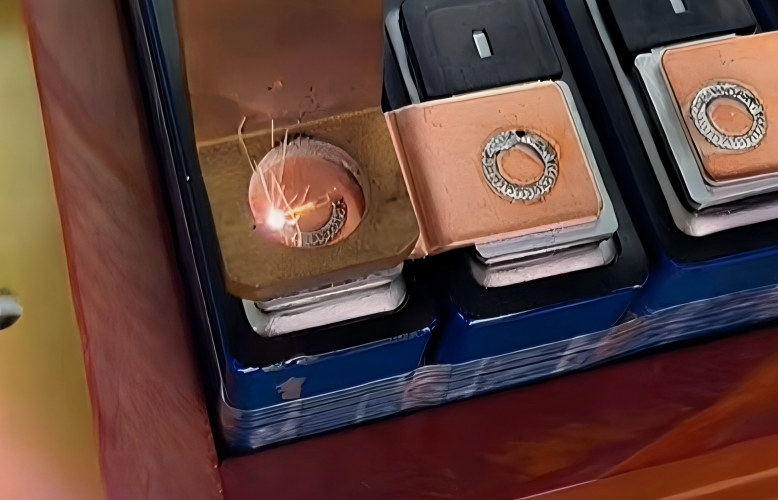
If you make battery packs for power tools, e-bikes, or small EVs, the tab weld is critical. A weak weld causes high resistance, heat buildup, and customer returns.
This guide covers practical tab laser welding for production managers and engineers: common materials, key parameters, a real case study, and a simple ROI estimate.
Why Tab Welding Is Critical
Key Laser Parameters for Tab Welding
Focus on these five adjustable parameters:
| Parameter | Typical starting range* | Effect |
|---|---|---|
| Peak power | 300-1500W | Penetration depth |
| Pulse width | 1-10ms | Heat input |
| Spot size | 0.2-0.6mm | Weld width |
| Welding speed | 20-80mm/s | For seam welding |
| Focus position | -0.2 to -0.5mm | Beam placement |
*These ranges are general starting points based on common industrial practice. Actual parameters must be determined through sample testing with your specific materials.
Most tab welding uses pulsed mode. Each pulse creates one small spot. Two to four spots per tab is typical.
Common Tab Materials and Approaches
| Material | Challenge | Laser approach |
|---|---|---|
| Nickel-plated steel | Easy to weld | Lower power, short pulse, 2-3 spots |
| Copper | High reflectivity | Higher peak power, tight focus |
| Aluminum | Oxide layer | Pulse shaping, moderate power |
| Nickel | Good weldability | Standard pulse, 3-4 spots |
Many small manufacturers struggle most with copper tabs. A 600-1000W pulsed fiber laser is a common industry choice for copper tabs up to 0.3 mm.
Case Study – Small EV Battery Pack Maker
The company: A U.S. manufacturer of battery packs for low-speed electric utility vehicles. Production: about 500 packs per month. Each pack has 56 cells, two tab welds per cell.
The problem: Resistance welding caused inconsistent weld quality as electrodes wore out. Reject rate was about 5%.
The solution: A 1000W pulsed fiber laser welder with vision positioning.
The results after six months:
| Metric | Before | After |
|---|---|---|
| Reject rate | ~5% | ~1% |
| Weld consistency | Poor | Good |
| Electrode cost | High | None |
| Operator training | 2 weeks | 2 days |
Based on customer feedback. Your results may vary.
Laser vs Resistance Welding for Tabs
| Factor | Laser Welding | Resistance Welding |
|---|---|---|
| Heat-affected zone | Small | Large |
| Electrode wear | None | High |
| Weld consistency | High | Variable |
| Material flexibility | High | Low |
| Upfront equipment cost | Higher | Lower |
| Long-term consumable cost | Lower | Higher |
This comparison is based on general industry benchmarks. Actual performance depends on equipment and materials.
Simplified ROI Estimate
The following is an example only. Use your own numbers.
Assumptions:
2,000 tab welds per day, 240 days/year
Scrap reduction: from 5% to 1%
Value per saved part: $4
Annual scrap saving calculation (example):
2,000 × 240 × 4% × 4=4=7,680
Equipment cost: 25,000−25,000−35,000. Payback: 3-5 years in this example.
⚠️ This is an illustrative estimate. Actual ROI depends on your production volume, part value, and local costs. Perform your own calculation.
Frequently Asked Questions
Q1: Can one laser welder handle both copper and aluminum tabs?
A1: Yes. Store different parameter sets for each material.
Q2: Do I need a vision system?
A2: Not for low volume. For over 500 welds per day, vision reduces rejects and pays for itself.
Q3: How do I validate before buying?
A3: Send samples to a laser applications lab for testing and parameter development.
Q4: Is handheld laser welding suitable for tabs?
A4: For low-volume repair or prototyping, yes. For production, a fixed system is better for consistency.
Q5: What safety precautions are needed?
A5: Use a Class 1 enclosure or laser-safety eyewear rated for the laser wavelength.
H2: Get Your Tab Welding Process Validated
You don’t have to guess if laser welding works for your tabs.
JOYLASER offers free sample testing.
Send us your tab materials (copper, nickel, aluminum, or nickel-plated steel). We’ll weld samples, run pull tests, and deliver a process report with recommended parameters.
👉 Request Your Free Battery Tab Welding Sample Test
Disclaimer: Technical information, parameter ranges, and cost estimates in this article are for general informational purposes only. Actual results depend on your specific materials, joint designs, and production conditions. Validate through sample testing before full production.