111-1024x458.png)
Struggling with copper-aluminum busbar welds?
Laser welding parameters, IMC control under 3μm, and free sample testing for EV battery manufacturers.
BLOG
CONTACT US
Copper to Aluminum Laser Welding for EV Battery Busbars
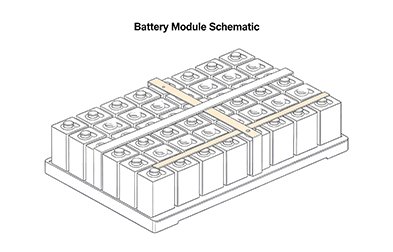
Why Copper to Aluminum Laser Welding Is Difficult in EV Battery Production
As EV battery designs become lighter and more power-dense, manufacturers increasingly need reliable copper-to-aluminum connections. However, welding these dissimilar metals remains one of the biggest challenges in battery pack assembly.
| Challenge | Explanation |
|---|---|
| Different melting points | Aluminum melts at 660°C (1220°F), while copper melts at 1085°C (1985°F) |
| Brittle intermetallic compounds (IMCs) | When copper and aluminum mix, they form a brittle layer that can crack under thermal cycling or vibration |
IMC growth is one of the most critical factors affecting weld reliability. If the IMC layer grows too thick (typically over 3 μm), the weld becomes weak and prone to failure — a serious reliability risk in EV battery packs during long-term thermal cycling and vibration exposure.
Note: The 3 μm figure is a general industry benchmark. Acceptable IMC thickness depends on your specific application.
Key Applications in EV Battery Manufacturing
You‘ll find copper-to-aluminum laser welding in several critical areas:
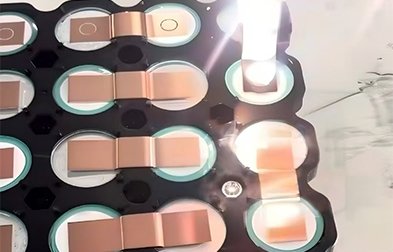
Busbars connecting cells – copper to aluminum transitions between battery cells
Module to pack connections – large-format busbars joining copper and aluminum sections
Tab to busbar welding – aluminum cell tabs connecting to copper busbars
Terminal posts – copper-aluminum transition joints at battery terminals
Recommended Laser Welding Parameters for Copper and Aluminum Busbars
| Process Parameter | Recommended Starting Range | Application Impact |
|---|---|---|
| Peak power | 1000–2000 W | Higher than single-material welding |
| Pulse shaping | Square or modulated | Controls IMC formation |
| Spot size | 0.4–0.8 mm (0.016–0.031 in) | Manages thermal gradient |
| Wobble amplitude | 0.5–1.5 mm (0.020–0.059 in) | Improves heat distribution |
| Focus position | Between materials | Balances heat input |
*These are general starting points. Actual parameters depend on your specific materials, thicknesses, and joint design. Validate through sample testing.
Best Laser Sources for Copper to Aluminum Welding
| Laser type | Effectiveness | Recommended application |
|---|---|---|
| Pulsed fiber laser (1064 nm) | Good for thinner materials | 0.5–1 mm (0.020–0.039 in) sections |
| Green laser (532 nm) | Excellent | High-reflectivity copper applications |
| QCW fiber laser | Very good | High-speed automated welding |
For most small to mid-sized battery manufacturers, a 1000–1500 W pulsed fiber laser with wobble capability is the most common starting point.
Laser Welding vs Other Methods for Copper to Aluminum Joints
| Factor | Laser Welding | Ultrasonic Welding | Brazing |
|---|---|---|---|
| IMC control | Good | Very good | Poor |
| Mechanical strength | High | Medium | Medium |
| Cycle time | <1 second | 1-2 seconds | Several seconds |
| Automation compatibility | Excellent | Medium | Medium |
| Joint thickness range | Best for 0.5–2 mm (0.020–0.079 in) | Best for <0.5 mm (0.020 in) | Any |
| Consumables | None | None | Filler material |
For EV battery busbars, laser welding offers the best balance of speed, strength, and process repeatability.
This comparison is based on general industry benchmarks. Actual performance varies with specific equipment and materials.
Case Example – 0.8 mm Copper to 1.0 mm Aluminum Busbar Welding
| Parameter | Value |
|---|---|
| Materials | T2 copper 0.8 mm (0.031 in) / 1060 aluminum 1.0 mm (0.039 in) |
| Laser source | 1500 W pulsed fiber laser |
| Welding speed | 30 mm/s (1.18 in/s) |
| Wobble amplitude | 1.0 mm (0.039 in) |
Results:
| Metric | Value |
|---|---|
| Penetration depth | 0.7–0.8 mm (0.028–0.031 in) |
| IMC thickness | 2.1 μm |
| Pull strength | 280 N (63 lbf) |
This is a representative example. Actual results depend on your specific materials and process conditions.
How to Validate Your Copper to Aluminum Welding Process
Before committing to a production laser welding setup:
Send your material samples to a laser applications lab such as JOYLASER for process validation
Run parameter development tests (Design of Experiments)
Evaluate weld quality through cross-section analysis and pull/shear testing
Target IMC thickness for EV battery applications is typically <3 μm — validate through application-specific testing.
Copper to Aluminum Laser Welding FAQ
Q1: Can a fiber laser weld copper to aluminum battery busbars?
A1: Yes, with sufficient peak power (1000 W+) and proper parameter tuning. Lower-power lasers may struggle with copper reflectivity.
Q2: What is the acceptable IMC thickness for EV battery applications?
A2: Industry benchmarks suggest IMC layers under 3 μm are generally acceptable. Validate through application-specific testing.
Q3: Do I need a green laser for copper to aluminum welding?
A3: Not necessarily. Pulsed fiber lasers work well for many applications. Green lasers offer better stability on thick copper but cost significantly more.
Q4: Can you test my materials before I buy equipment?
A4: Yes. JOYLASER offers free sample testing with a process report and weldability analysis.
H2: Ready to Test Your Copper-Aluminum Welding Project?
Before investing in equipment, validate your process with real samples.
With JOYLASER sample testing, you can receive:
✅ Weldability analysis for your specific copper and aluminum materials
✅ Recommended laser source and process parameters
✅ Cross-section and IMC inspection report
✅ Process feasibility feedback within 3–5 business days
Send your samples today and get a custom welding solution for your production line.
👉 [Request Free Sample Test]
Disclaimer: Technical information, parameter ranges, and IMC targets are based on general industry practices. Actual results depend on your specific materials, thicknesses, and production conditions. Validate through sample testing before full production.