111-1024x458.png)
Robotic Laser Welding: Cost, ROI, and When to Automate
Payback periods, productivity gains, and a simple framework to decide if automation is right for your shop.
BLOG
CONTACT US
Robotic Laser Welding: Cost, ROI, and When to Automate Your Shop
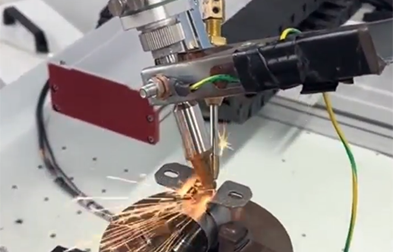
If you’re a U.S. manufacturer facing rising labor costs, inconsistent weld quality, or a shortage of skilled welders, you‘ve probably thought about automation. But the question is always the same: Does it actually pay off?
The short answer: for many shops, yes. A well-specified robotic laser welding cell typically achieves full payback in 12 to 24 months.
This guide breaks down the real numbers behind robotic laser welding — productivity gains, labor savings, quality improvements, and a simple framework to calculate ROI for your own shop.
All cost and performance data in this guide are based on industry averages and representative examples. Actual results vary by application, region, and production conditions.
Why U.S. Manufacturers Are Moving to Robotic Laser Welding
Three converging pressures are driving the shift:
1. The Skilled Welder Shortage Is Getting Worse
The welding industry faces a structural labor shortage that is accelerating, not improving. Experienced welders are retiring faster than new ones are being trained. Recruiting and retaining qualified welding staff is increasingly expensive and unreliable — creating a direct bottleneck on production capacity.
The U.S. is projected to need over 320,000 new welders by 2029 to meet manufacturing demand.
2. Labor Costs Are Rising
In developed markets, wage inflation is a consistent reality. Every percentage point increase in labor costs directly compresses margins — unless you reduce dependency on manual labor.
3. Quality Consistency Is a Competitive Requirement
Modern supply chains demand documented, repeatable quality. Manual welding — even by skilled operators — introduces variability that creates rework, scrap, and customer complaints. Automated systems eliminate this variability at the source.
The Productivity Advantage: 2 to 5× Faster Than Manual Welding
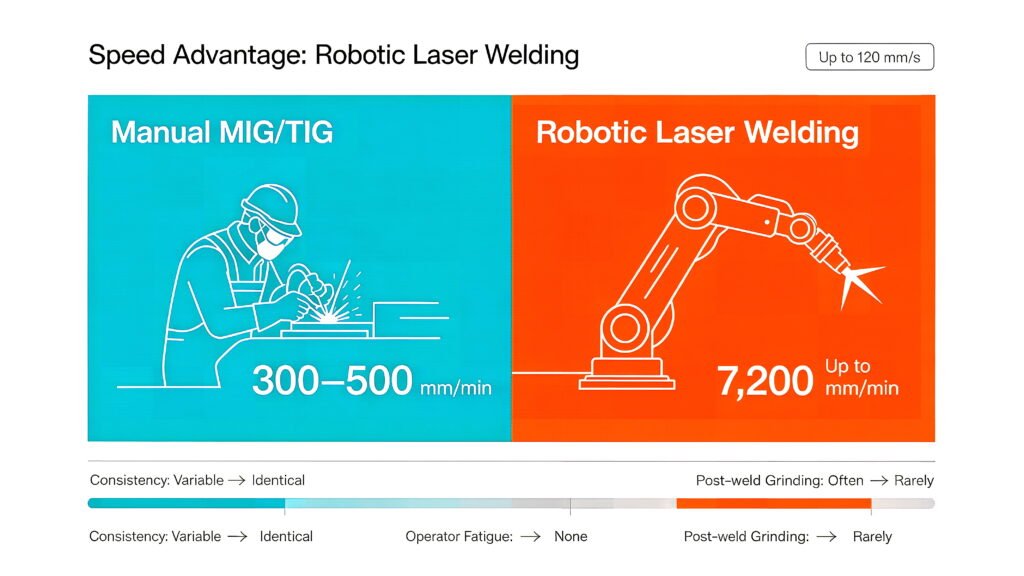
Robotic laser welding operates at speeds 2 to 5 times faster than conventional manual welding, with maximum welding speeds of up to 120 mm/s.
| Metric | Manual MIG/TIG | Robotic Laser Welding |
|---|---|---|
| Typical welding speed | 300–500 mm/min | Up to 7,200 mm/min (120 mm/s) |
| Consistency per cycle | Variable | Identical every cycle |
| Operator fatigue impact | Significant after 2–4 hours | None |
| Post-weld grinding required | Often | Rarely |
| Shift coverage | Limited by human hours | 24/7 capable |
Speed comparison based on typical industrial data. Actual speed varies with material, joint design, and application.
Real-world example: One California machine shop switched from manual TIG to robotic fiber laser welding and increased production from 10-30 parts to 45-60 parts per hour. The shop eliminated post-weld straightening and reduced labor requirements by half.
Source: Industry case study. Your results may vary.
Cost Breakdown: What a Robotic Laser Welding Cell Actually Costs
Typical cost range: $80,000 – $300,000+ for a complete single-robot welding cell. Industrial-grade 6-axis robotic systems with higher payload capacity and integration complexity can range from $150,000 to $500,000+.
For most mid-sized fabrication shops, a $80,000–$150,000 entry-level cell is the most common starting point for a complete, ready-to-run system.
What‘s included:
Robot arm (6-axis collaborative or industrial)
Fiber laser source (power 1kW–4kW+)
Welding head with wobble/scanner options
Part fixturing and tooling
Safety enclosures and interlocks
Control software and programming
Installation and commissioning
Pricing based on industry equipment cost guides. Actual prices vary by configuration, brand, and integration requirements.
ROI: Real-World Payback Periods for U.S. Shops
Annual Operating Cost Comparison (Mid-Sized Fabrication Facility)
| Cost Category | Manual Welding Operation | Robotic Laser Welding | Annual Saving |
|---|---|---|---|
| Direct labor (2 welders) | ~$60,000 | ~$10,000 (1 operator) | ~$50,000 |
| Rework & scrap | $8,000–$12,000 | $1,000–$2,000 | $7,000–$10,000 |
| Consumables (wire, gas, tips) | $5,000–$7,000 | $2,000–$3,000 | $3,000–$4,000 |
| Unplanned downtime | $6,000–$10,000 | $500–$1,500 | $5,500–$8,500 |
| Total Annual Cost | ~$79,000–$99,000 | ~$13,500–$16,500 | ~$62,500–$82,500 |
These figures are representative estimates based on typical mid-sized metal fabrication operations in developed markets. Actual savings vary by region, labor rates, and shift patterns.
Payback Period Examples:
| Application | Payback Period | Source Reference |
|---|---|---|
| Door-beam welding | ~12 months | EVS TECH case study |
| Battery-shell laser welding | ~6 months | EV battery producer |
| Typical mid-sized fab shop | 12–24 months | Industry benchmarks |
| Ceiling air diffuser welding | <12 months | AMADA case study ($1M annual savings) |
| Collaborative robot welding | <12 months | Industry supplier data |
One cell typically replaces 2–3 manual welders per shift. In a two-shift operation, this translates to 4–6 welder equivalents. At average loaded labor costs of $55,000–$75,000 per welder per year in developed markets, the annual labor saving ranges from $220,000 to $450,000.
Where Automation Makes Sense (and Where It Doesn‘t)
Robotic laser welding is a good fit when:
| Condition | Why |
|---|---|
| High-volume production runs | The robot’s speed and consistency pay off quickly |
| Complex or repetitive geometries | Robots maintain precise paths, manual welders struggle |
| Thin materials | Laser welding minimizes heat distortion |
| Visible weld appearance matters | Smooth, consistent seams without grinding |
| Skilled labor is scarce or expensive | Reduces dependency on hard-to-find welders |
| 24/7 production required | Robots don‘t need breaks or shift premiums |
Robotic laser welding may NOT be the right fit when:
| Condition | Why |
|---|---|
| Low-volume, high-mix production | Programming and fixturing costs may not justify automation |
| Very thick materials (>10mm) | Arc welding may be more cost-effective |
| Highly variable parts | Requires frequent reprogramming and new fixtures |
| Tight budget | Entry-level handheld laser may be a better starting point |
For small to mid-sized shops with lower volumes, ahandheld laser welder may offer a better ROI. Once production scales up, robotic automation becomes the logical next step.
How to Calculate ROI for Your Own Shop
Use this simple framework to estimate payback for your facility:
Step 1: Calculate your current annual welding labor cost
Number of welders × Annual salary/wage = Total annual welding labor cost
Step 2: Estimate your annual rework & scrap cost
Monthly rework/scrap cost × 12 = Annual quality failure cost
Step 3: Estimate your annual consumable & downtime cost
(Monthly consumables + Monthly downtime losses) × 12 = Annual operational cost
Step 4: Add up total annual manual welding cost
Labor + Rework/Scrap + Consumables + Downtime = Total Annual Cost (Manual)
Step 5: Estimate robotic system annual cost
Operator oversight + Maintenance + Consumables = Total Annual Cost (Robotic)
Step 6: Calculate annual saving & payback period
Annual Saving = Total Annual Cost (Manual) − Total Annual Cost (Robotic)
Payback Period = Machine Investment ÷ Annual Saving
Case Example – Factory Automation in Action
Challenge: A sheet metal fabricator producing enclosures and brackets relied on 3 manual MIG welders. Increasing order volume was creating a bottleneck, and one senior welder was approaching retirement.
Solution: The shop installed a robotic laser welding system to handle high-volume repetitive welds at 2–5× the speed of manual welding.
Results:
| Metric | Before | After |
|---|---|---|
| Production capacity | Baseline | +300% |
| Labor cost | Baseline | -40% |
| Weld consistency | Variable | Fully consistent |
| Senior welder position | 1 retiring | Not replaced |
This is a representative example based on industry case studies. Your results may vary.
Frequently Asked Questions for U.S. Manufacturers
Q1: How quickly can a robotic laser welding machine pay for itself?
A1: For most mid-sized manufacturing operations, full payback is achieved in 12 to 24 months. Operations with higher labor costs or larger production volumes often see payback in under 12 months.
Q2: How much faster is robotic laser welding compared to manual welding?
A2: Robotic laser welding operates at 2 to 5 times the speed of conventional manual welding, with maximum welding speeds up to 7,200 mm/min. Unlike manual welders, the robotic system maintains this speed consistently across every cycle.
Q3: Do I need specialized staff to operate the system?
A3: No. Most systems feature intelligent control designed for ease of use. Comprehensive operator training is typically provided. Most operators achieve productive operation within a short training period — no prior robotic welding experience is required.
Q4: What is the typical ongoing maintenance cost?
A4: Robotic laser welding systems are designed for low-maintenance operation. Built-in automatic gun cleaning eliminates the most common cause of unplanned downtime. Most suppliers provide 24/7 technical support.
Q5: Can a robotic laser welder handle multiple different parts?
A5: Yes. The robot arm can be reprogrammed for different part geometries and weld paths. Systems support multiple weld types — including fillet, spot, seam, and wobble welding — making them highly versatile across different production requirements.
Q6: How do I know if my shop is ready for robotic automation?
A6: A good rule of thumb: if 40–80% of your work is being touched by a welder, you need to take a serious look at laser welding technology. Contact JOYLASER for a free automation assessment.
Need Help Deciding If Automation Is Right for You?
Not sure if your shop is ready for robotic laser welding? JOYLASER offers free automation assessments for U.S. manufacturers.
✅ Production capacity analysis
✅ ROI projection based on your specific operation
✅ Equipment recommendation tailored to your needs
👉 Request Free Automation Assessment
Disclaimer: All cost estimates, productivity gains, and payback periods are based on industry averages and representative case studies. Actual results vary based on your specific production volume, labor rates, part complexity, and operating conditions. Always validate with a detailed analysis before investing.