111-1024x458.png)
Handheld Laser Welding for Thin Sheet: Clean, Fast, No Deformation
0.5-4mm stainless steel, aluminum, carbon steel. No post-weld grinding. Free sample testing.
BLOG
CONTACT US
Handheld Laser Welding for Thin Sheet: Clean, Fast, No Deformation
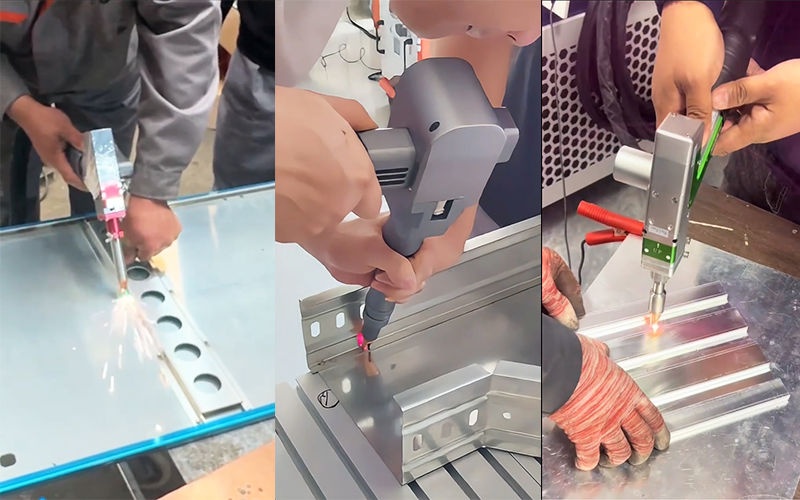
If you weld thin sheet metal — stainless steel, aluminum, or carbon steel under 4mm — you know the struggle. TIG is painfully slow. MIG creates spatter and distortion. Both require hours of grinding and polishing to make the weld look presentable.
Handheld laser welding changes that.
It produces clean, strong welds with minimal heat input, virtually no distortion, and little to no post-weld grinding. New operators can be trained in hours, not months. And with welding speeds up to 10x faster than TIG on thin sheet, it‘s not just a quality improvement — it’s a productivity game-changer.
This guide covers what handheld laser welding can do for thin sheet fabrication, which materials and thicknesses it handles best, and how to decide if it‘s right for your shop.
All data in this guide are based on publicly available industry information and manufacturer specifications. Actual results vary by application and operating conditions.
What Makes Thin Sheet Welding Difficult (and Why Laser Works)
Thin sheet metal — typically 0.5mm to 4mm — is challenging because it has very little mass to absorb heat. Traditional TIG and MIG welding pump large amounts of heat into the part, causing warping, distortion, and a large heat-affected zone (HAZ). This often means hours spent on straightening, grinding, and polishing.
MIG welding creates significant spatter that must be ground off — a costly, non-value-added step. TIG welding is cleaner but extremely slow and highly skill-dependent. Both methods require years of experience to master.
Handheld laser welding solves these problems by concentrating energy into a very small spot. The heat input is low, the HAZ is minimal, and distortion is virtually eliminated even on thin sheets.
According to Fraunhofer IPK, handheld laser welding is characterized by “concentrated and directed energy input compared to conventional arc-based processes,” resulting in “a smaller heat affected zone, even with thin sheets, as well as less distortion and therefore less straightening”
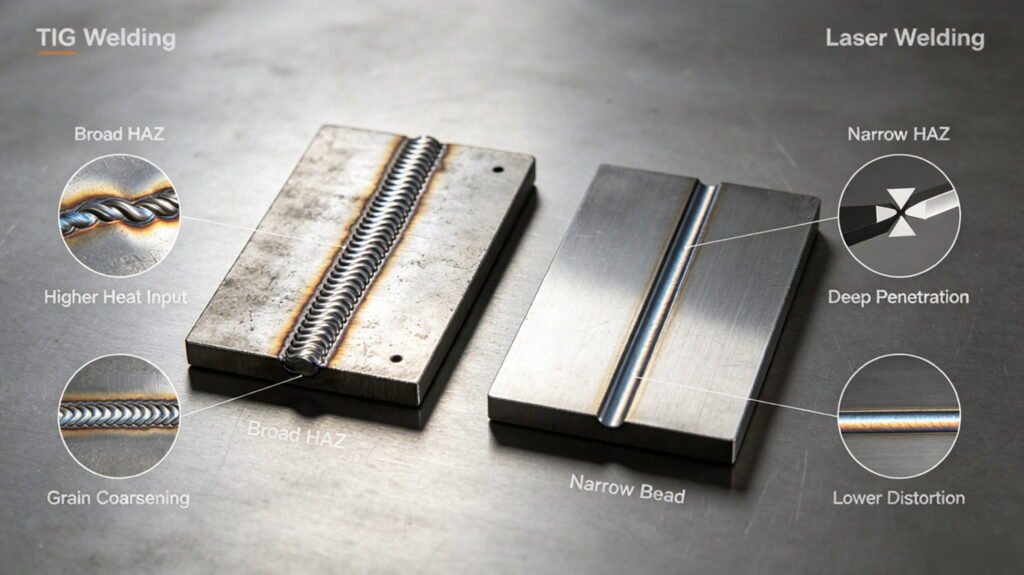
Speed Comparison: Laser vs TIG vs MIG on Thin Sheet
Speed is where handheld laser welding really shines. According to industry testing:
| Metric | TIG | MIG | Handheld Laser Welding |
|---|---|---|---|
| Speed on thin sheet | Baseline | 1-2x faster than TIG | 4-10x faster than TIG |
| 0.5-1.5mm stainless | Slow | Moderate | Very fast, clean seams |
| Operator learning time | Months to years | Months | Hours to days |
| Post-weld grinding | Required | Required (spatter) | Virtually none |
A 1500W handheld laser welder can weld up to four times faster than TIG and twice as fast as MIG, while producing consistent, high-quality seams and joints with minimal training.
For thin stainless steel (0.5-1.5mm), laser welding produces smooth, narrow seams with very low discoloration when gas flow and parameters are optimized. Many fabricators report sending parts directly from welding to powder coating without intermediate grinding.
Speed comparison based on manufacturer data and industry benchmarks. Actual speeds vary by material, thickness, and joint design.
The “No-Deformation” Advantage — Why Laser Works on Thin Metal
The biggest concern with thin sheet welding is distortion. Traditional methods pump heat into a large area, causing the sheet to warp, buckle, or discolor.
Handheld laser welding changes this by concentrating energy precisely where it‘s needed. Fraunhofer IPK confirms that “the concentrated and directed energy input” results in “a smaller heat affected zone, even with thin sheets, as well as less distortion and therefore less straightening”.
The weld appearance is also superior. Laser welding produces clean, aesthetically perfect welds with zero spatter, completely eliminating the post-weld grinding and cleanup step. For visible welds on kitchen equipment, medical devices, or architectural metalwork, this is a major selling point.
For laser welding thin sheet, the weld bead is smooth and often requires no grinding — parts can go directly to painting or assembly.
What Materials and Thicknesses Can It Handle?
Handheld laser welding handles a broad range of thin sheet materials and thicknesses, based on industry data:
| Material | Thickness Range | Typical Applications | Recommended Power |
|---|---|---|---|
| Stainless Steel | 0.5-4mm | Kitchen equipment, medical devices, enclosures | 1000-1500W |
| Carbon Steel | 0.8-4mm | Machine frames, structural parts | 1200-1500W |
| Aluminum | 1-4mm | Lightweight components, housings | 1200-1500W |
| Galvanized Steel | 0.5-2mm | HVAC, ductwork, automotive | 1000-1500W |
| Copper | 0.5-2mm | Electrical connections, heat exchangers | 1500W+ |
Thickness ranges based on manufacturer specifications and industry benchmarks. Actual capabilities vary by power, material, and joint design.
Fraunhofer IPK notes that handheld laser welding can join “unalloyed, low alloyed and high alloyed steels, as well as weldable aluminum and nickel-based alloys. Titanium and copper alloys can also be processed”.
According to industry welding data, a 1200W handheld system produces full penetration welds on 0.8mm stainless steel lap joints with minimal discoloration. Even at the upper range, 4mm carbon steel fillet welds are achievable with proper parameter control.
For 22 gauge (0.5-1mm) stainless, a 1500W system with the right settings produces consistent, high-quality welds with virtually no distortion
When to Choose Handheld (vs Desktop or Automated)
Handheld laser welding is not a replacement for every application — it’s a tool for the right jobs.
Choose handheld laser welding when:
| Condition | Why |
|---|---|
| High-mix, low-volume production | Job shops and custom fabricators benefit from flexibility |
| Complex geometries | The handheld torch reaches areas robots can‘t |
| On-site repair or installation | Portable, no fixed workstation needed |
| Visible welds | Clean appearance eliminates post-processing |
| Thin sheet fabrication | Minimal distortion, no grinding |
Consider desktop or automated when:
Very high-volume, identical parts (automotive production)
24/7 operation required
Parts are large or heavy — but even then, handheld is gaining ground
According to Fraunhofer IPK, handheld laser welding is “particularly suitable for applications that require high welding precision, minimal distortion or thin sheet thicknesses,” and is “primarily used in custom manufacturing and for small batch sizes”.
Frequently Asked Questions
Q1: Is handheld laser welding really “no deformation” on thin sheet?
A1: Yes. The concentrated energy creates a very small heat-affected zone, which means minimal thermal stress and virtually no warping, even on 0.5mm stainless.
Q2: What thickness can a handheld laser welder handle?
A2: Most systems handle 0.5mm to 4mm thin sheet, with some reaching 6.5mm on stainless. The sweet spot for “no-deformation” welding is under 4mm.
Q3: Does it replace TIG welding?
A3: Not completely. It complements TIG — replacing it on thin sheet, repetitive jobs, and visible welds. TIG still has advantages on very thick sections and specialty materials.
Q4: Is post-weld grinding always eliminated?
A4: In most cases, yes. Laser welding produces clean, spatter-free welds with no grinding required. For some applications, light polishing may be needed — but far less than TIG or MIG.
Q5: What’s the learning curve?
A5: According to industry sources, basic operation can be learned in 30 minutes to a few hours, with proficiency in days rather than months.
Q6: What materials can it weld?
A6: Stainless steel, carbon steel, aluminum, titanium, copper, nickel alloys, and even dissimilar metals.
Ready to Test Thin Sheet Laser Welding on Your Parts?
You don’t have to guess if handheld laser welding works for your thin sheet applications. JOYLASER offers free sample testing for U.S. manufacturers.
✅ Test on your actual materials and thicknesses
✅ See the results — clean, no-deformation welds
✅ Get recommended parameters for your shop
👉 [Request Free Sample Test for Thin Sheet Welding]
Disclaimer: All performance data, speed comparisons, and thickness ranges are based on publicly available industry information, manufacturer specifications, and representative examples. Actual results vary based on specific materials, thicknesses, joint designs, and operating conditions. Always test with your own parts before making a purchase decision.